
The 12 Essential SaaS Trends You Should Watch Out For In 2024
Software-as-a-service (SaaS) is becoming an increasingly viable choice for organizations in search of accessibility, functionality, and versatility in a cutthroat business environment.
It’s possible for companies to run SaaS software solutions and online data analysis without the need to rely on installing and running applications on their own computer systems and data centers. As such, these incredible innovations are rising in popularity every year.
SaaS now dominates the cloud computing market. Gartner predicts that the spending on public cloud services is forecasted to reach $679 billion in 2024 - a level of growth that will shape software as a service trends in the coming year.
SaaS is a software distribution model that offers a lot of agility and cost-effectiveness for companies, making it an incredibly reliable option for numerous business models and industries. It’s also popular among companies due to its simplicity, user accessibility, security, and widespread connectivity. In turn, software-as-a-service platforms streamline business models, resulting in maximum efficiency across the board. Today, most companies are in the process of implementing various business intelligence strategies, turning to SaaS BI tools to assist them in their efforts.
Last year was a breakthrough year for the SaaS world in many ways. With a new year on the horizon, in this article, we’ll explore 12 essential SaaS trends that will stand out in 2024 - developments that are pushing the SaaS market envelope even further.
But, before we do that, we will discuss the general characteristics revolving around the industry that will help put additional light on the SaaS trends 2024.
Soon, we’ll be digging deeper into game-changing software-as-a-service concepts. But before looking at our top SaaS industry trends for 2024, let’s dispel some common myths surrounding the market.
Dispelling 3 Common SaaS Myths
To offer you a full and panoramic understanding of the impact software-as-a-service is having on the professional world and get the best context of the latest SaaS opportunities and trends, here, we will dispel the three most common SaaS myths – consider them busted:
- SaaS tools offer just one application: On the contrary, SaaS tools range in form and function as much as any other type of software available today, so you can build a SaaS dashboard tool or use a SaaS-based email marketing solution, for example.
- SaaS is less robust and less secure than on-premises applications: Despite some SaaS-based teething problems or technical issues reported by the likes of Google, these occurrences are incredibly rare with software-as-a-service applications – and there hasn’t been one major compromise of a SaaS operation documented to date.
- IT professionals are anti-SaaS: Again, this is a complete myth, and like any disruptive development worth its salt, some IT professionals are reluctant to embrace SaaS as a concept. There are a large number of experts who recognize SaaS for ridding them of the day-to-day humdrum of traditional software while helping them better manage their own IT operations. This quote from Apple’s prolific founder, Steve Jobs, sums up the common view of SaaS from a technical professional’s perspective: “I don’t need a hard disk in my computer if I can get to the server faster…carrying around these non-connected computers is byzantine by comparison.”
SaaS: The Key Characteristics
Before we explore our essential software-as-a-service trends for 2024, it’s important to consider what defines SaaS as not only technological development but as a working business model.
- Flexible payment options: Businesses don’t have to go through the expense of purchasing software and hardware. Instead, they have the option of utilizing various pricing structures. Flexibility in payment models, where they only pay for the resource usage they need, for instance, is attractive for many organizations in today’s competitive world.
- Scalability: Cloud-based SaaS enables organizations to expand easily due to its inherent scalability. Companies can be selective about the types of features and options they want.
- Updates: SaaS providers handle the necessary software updates and develop innovative features over time, so businesses don’t have to invest ample amounts of time in this particular area of operation.
- Accessibility: With SaaS, companies have the mobility to access applications from any digital device and location, making it especially convenient for mobile platforms. Additionally, it boasts ease of use and is user-friendly.
- Adaptability: Due to the seemingly limitless level of scalability, accessibility, and insight SaaS innovations offer, companies that use such tools or platforms will become far more adaptable to constant change or unforeseen organizational roadblocks.
- Increased collaboration: SaaS developments enhance a business’s ability to promote collaboration across teams and departments due to the facilitation of file sharing, in addition to distinct ease of reading and understanding across systems.
- Security: Most SaaS models are known for their enterprise-level security, which is a more holistic approach to security than many centralized, on-premise solutions. In Cloud SaaS, pre-existing disaster recovery protocols are in place to manage potential system failures. This means that your business’s data is available and secure regardless of a breach or system failure.
As businesses continue to rely on innovative data discovery tools and technologies to increase both their productivity and their efficiency, and as new software-as-a-service trends continue to emerge, this young, groundbreaking industry can only go from strength to strength.
Even if figures diverge somewhat, the many forecasts conducted on SaaS industry trends in 2024 demonstrate an obvious reality: the SaaS market will get bigger and bigger. Indeed, according to Technavio, the public cloud platforms, business services, and applications (SaaS) market size is estimated to grow at a CAGR of 19.19% between 2022 and 2027. Reaching a value of US 313.45 billion, a big increase compared to US 107.78 billion in 2017. And according to Gartner, the global public cloud service market is projected to grow significantly in 2024 and beyond.
Without further ado, let's dive into the most important trends of the SaaS industry for the coming year!
Explore our 14-days free trial today & experience these trends in action!
The Top 12 SaaS Trends In 2024
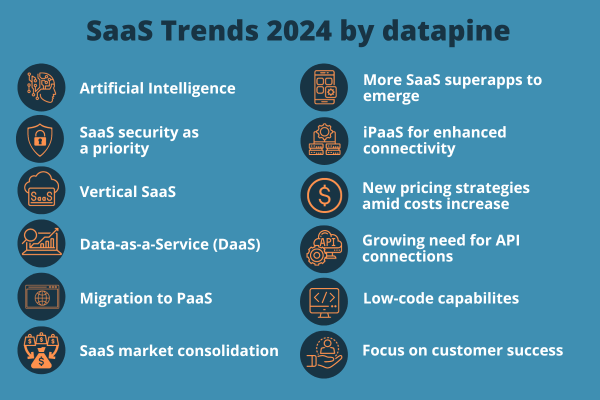
Now that we’ve explored the key characteristics of software-as-a-service innovations, it’s time to dive deeply into the top SaaS trends in 2024.
From introducing artificial intelligence to enhanced mobile optimization and beyond, these SaaS trends will shape the sector at the dawn of the new year.
Read more here : https://www.datapine.com/blog/saas-trends/

Recent Post
-

Codexchangemarket Author Fee Structure with Discount
27 Mar, 2024
-

Codexchangemarket Author Fee Structure
27 Mar, 2024
-

11 Key Software Development Trends (2024-2026)
10 Sep, 2022
-
